Fair Trade For Moms

Mom always said, “play fair.” This is just one of the many lessons we have taken to heart from the loving voices of our mothers. Fair trade embodies the sense of fairness our mothers wanted to instill in us. A good mother wants to bring out the best in her children, witnessing them take others’ feelings into consideration, waiting patiently for them to overcome their self-centered early phases.

Sevya wishes to inspire our customers to consider all the wonderful lessons we have gained from our mothers. A sense of compassion is one of the greatest gifts a mother can give her children. We are truly lucky if we have been given this powerful perspective, this wise way of living. Out of this spirit of compassion we can do great things for our world. Sevya wants to celebrate the motherly message of compassion that we are so lucky to share with so many worldwide. We hope that by creating a means to empower communities of artisans and to also turn any profits toward good works in India, we are realizing the power of this message as best we can.

Tying Knot for Bandhani Scarf- part of Sevya's fair trade scarves collection.

Tying Knot for Bandhani Scarf- part of Sevya’s fair trade scarves collection.

This Mother’s Day, we at Sevya wish to celebrate all motherly voices of compassion. We hope to encourage all who believe in living compassionately to raise our voices together to celebrate our mothers for teaching us these lessons, usually not so much through words, but through actions. We want to encourage continued compassionate action wherever we can. Our organization is designed to empower entire communities of artisans by providing decent, sustainable livelihoods. We want to express our concern for all living beings on this planet, showing our dedication to environmentally sound production practices such as zero electricity use in village textile production. We want to respect our mothers’ countless acts of kindness and their insistence on sustainability in this way.

Indian women artisans who produce retail and wholesale scarves for Sevya's fair trade collection.

Indian women artisans who produce retail and wholesale scarves for Sevya’s fair trade collection.

Sevya’s retail and wholesale scarves are excellent examples of artisan-created, fair trade textiles that are earning a well-deserved reputation for elegance, beauty and refinement. When one learns the background stories behind these articles, one encounters a much deeper meaning behind these beautiful garments. Communities are thriving where there were previously little opportunities. All profits go to the All India Movement, a wonderfully effective grassroots movement that has been building schools, housing and infrastructure necessary to lift many people out of poverty in India.

A spinner works on fair trade clothing production for Sevya.

A spinner works on fair trade clothing production for Sevya.

This Mother’s Day and beyond, Sevya wishes to celebrate the nurturing and compassionate voices in our lives that we have been blessed with by our mothers. Sevya offers a wide range of retail and wholesale fair trade products that embody this sense of compassion. Please consider supporting truly fair trade practices when you shop for clothing, jewelry, decor, bedding, cards and other items where fair trade choices are available.

Kavida Floral Tunic-- Part of Fair Trade Clothing Collection by Sevya

Kavida Floral Tunic– Part of Fair Trade Clothing Collection by Sevya

Jerry Rasch writes for Sevya as a part-time, but full-hearted pursuit.

Posted in Sevya | Leave a comment

Fair Trade Practices Redefine the Word Heirloom

An artisan embroiders a garment in the chikankari style for Sevya's fair trade clothing collection.

An artisan embroiders a garment in the chikankari style for Sevya’s fair trade clothing collection.

Heirloom Quality

For the past few months I have been referring to some of Sevya’s finest creations as “heirloom quality” items. At first I was simply referring to the most common definition of “heirloom”; but after a little reflection, a more global definition of is in order. When people think of heirlooms they are usually thinking of items of special value, worthy enough to pass on to descendants. Certainly, the expertly crafted, fair trade items I have referred to in the Sevya collection fit this conventional definition. Yet a deeper understanding of the word “heirloom” would consider not only passing the item itself on to our descendants, but also passing on a heritage of sustainability, preservation and compassion to all living beings that come after us on this planet.

A New Definition of Heirloom: Leaving Behind a Better World

Perhaps it is “natural” to rely on instinct and/or logic to look out for our own flesh and blood. Yet, it is also obvious that we are all connected. The interdependency shows up in environmental, social and cultural manifestations.

Environmental

What goes in our air, soil, water and food affects us. If entities produce outwardly beautiful garments but poison the workers, the soil, water and air, they really have not produced a beautiful garment at all. In fact they have produced something of a nightmare that future generations will have to deal with. Artisan cooperatives that weave Sevya garments use zero electricity. This fact, along with non-toxic application of dyes, is a primary means of promoting positive environmental stewardship. In fact, consumers can choose fair trade cotton garments with ayurvedic, herbal medicinal dyes. Very few garments in the world are as responsibly made.

Social

The World economy is made up of countless relationships where exchanges are made between winners and losers, losers and losers, and, sometimes, between winners and winners. Unfortunately, the latter scenario is quite rare. More often than not, the empowered parties in global exchanges simply add more power and wealth to their already dominant position. The winners gain cheap goods through cheap labor and natural resources; while the losers are left with a crippling cycle of poverty and environmental destruction. Conversely, through true fair trade practices, both parties in an exchange can benefit. In order for both parties to “win” there should be great value in all facets of the exchange, and, above all else, sustainability should be attained on both sides of the exchange. Truly fair trade practices empower those who were previously powerless, while enriching and invigorating the lives of those who purchase the healthy produce and beautiful keepsake items.

Fair trade organizations such as Sevya contribute to a movement where schools are built, educations are attained, and healthy, sustainable livelihoods are created for entire communities. On the other side of the exchange, a much deeper, more purposeful engagement in our planet’s future can be attained by those who purchase these goods. It is up to we who invest in fair trade goods to come up with a perspective that truly creates heirlooms—in this deeper, more global sense of the word– through these exchanges.

A group of artisans using traditional embroidery techniques.  Sevya supports traditional practices in production for the fair trade wholesale and retail markets.

A group of artisans using traditional embroidery techniques. Sevya supports traditional practices in production for the fair trade wholesale and retail markets.

Cultural

Fair trade practices demand that traditional cultures are respected through the creation of sustainable sources of employment. Another way cultural traditions are respected is through the support for artisan communities where traditional approaches to religion, medicine and all other facets of culture are allowed to thrive. For example, unlike in factory production models, artisan communities where Sevya products are made often take long breaks to celebrate religious holidays. Many more examples can be found throughout Sevya’s production of retail and wholesale scarves, clothing and other items in artisan communities.

One of many beautiful heirloom quality fair trade scarves with a lovely example of fair trade jewelry-- brass cuff bracelet.

One of many beautiful heirloom quality fair trade scarves with a lovely example of fair trade jewelry– brass cuff bracelet.

Our world is constantly changing, and our children will inevitably inherit the effects of changes we set in motion. Perhaps the fact that fair trade practices are currently creating powerful, sustainable solutions in our world is worth our respect, our best efforts and our support. We really can leave the finest possible heirloom for our descendants: a healthy, sustainable world.

Sevya offers a wonderful variety of heirloom quality items, in both the conventional and this more global definition of “heirloom.” Looking through our collections is a feast for the eyes. Many elegant and refined examples can be found in our collection of fair trade clothing, scarves, jewelry, home décor, bedding, cards and more. Consider a purchase of a true heirloom today!

Jerry Rasch writes articles such as this as a part time but full-hearted pursuit.

Posted in Sevya | Leave a comment

Make Every Day Earth Day by Supporting Fair Trade

As many scholars and thoughtful observers have so often pointed out, environmental issues are really social and cultural issues as well. This Earth Day, we at Sevya would like to take a look through a particular lens to observe some of the ways the health of our planet depends upon trading practices that respect the environment and empower the communities that produce goods. Since we work primarily with textiles, our focus will be to compare sustainable, fair trade textile production with conventional factory production. We also want to take this opportunity to introduce our line of fair trade, organic, ayurvedic (herbal medicinal) scarves. No other source for retail or wholesale scarves offers this combination of personal, global and environmental benefits. Moreover, once you have seen this collection you might agree that no other options are as tasteful.

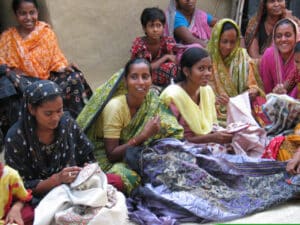
Artisan Women's Self Help Group. Sevya promotes sustainability for Cooperative Groups through sales of fair trade clothing, retail and wholesale scarves, etc.

Artisan Women’s Self Help Group. Sevya promotes sustainability for Cooperative Groups through sales of fair trade clothing, retail and wholesale scarves, etc.

This Earth Day it is particularly relevant to consider the fair trade principle called “Cultivating Environmental Stewardship.” From the website for the Fair Trade Federation, the following definition of this principle sums it up: “Fair Trade seeks to offer current generations the ability to meet their needs without compromising the ability of future generations to meet their own needs. Members actively consider the implications of their decisions on the environment and promote the responsible stewardship of resources. Members reduce, reuse, reclaim, and recycle materials wherever possible. They encourage environmentally sustainable practices throughout the entire trading chain.”

This principle is seen in a number of ways in Sevya’s fair trade textile production. First of all, no electricity is used in any stage of handmade textile production. Fixing the dye to yarn is done on wood fires. Ironing is done with coal irons, and washing is all by hand. Our herbal medicinal options use grapefruit extract instead of bleach for whitening and cleaning of the yarn. Bicycle pedal power is employed when spinning of yarn prior to weaving. Weaving is done on pit looms, with foot and hand operated pedal power. Finally, tasseling is by hand.

Weaving an intricate, elegant scarf for Sevya’s retail and wholesale scarves collection.

Weaving an intricate, elegant scarf for Sevya’s retail and wholesale scarves collection.

Sevya’s commitment to sustainability does not stop with zero electricity use. Our herbal dyed and organic cotton options offer the ultimate in eco-friendly materials and process, with significant advantages for both producers and consumers alike. The highest standards of weaving excellence are met in an impressive line of handmade, fair trade organic cotton scarves with ayurvedic, herbal medicinal dyes. The indigo blue example features a light and lovely weave pattern with simple white stripes offsetting the soft indigo hues. Indigo is a natural aid against stress, anxiety and depression. Combined with the aesthetic qualities and softness against the skin, the medicinal effects of indigo complete a perfect package for yourself and the world. Other dye options such as sandalwood, galangal, neem and haritaki cover a wider range of medicinal effects and these scarves also include silk and various weave options. What a novel Earth Day gift idea for self and others!

Ayurveda Indigo Silk Scarf- Part of Fair Trade Herbal Medicinal Scarf Collection by Sevya

Ayurveda Indigo Silk Scarf- Part of Fair Trade Herbal Medicinal Scarf Collection by Sevya

To these clear and powerful benefits we can add the many benefits to communities of artisans who can realize a sustainable future. The weaving cooperatives allow entire communities a stability and prosperity unheard of in factory models. Consumers who purchase high quality, fair trade ayurvedic scarves are choosing sustainability over the notion that relationships and products can and should be disposable. Consider this: when you make something of high quality that will be cherished, not abused and thrown away quickly, you have made a practical item that deserves respect, earns its keep and is not replaced. We need to nurture this concept with the material world we create as well as in our relationships. What better way to celebrate Earth Day than to invest in a fair trade, organic cotton, ayurvedic-dyed scarf?

Ayurvedic Galangal Fair Trade Cotton Scarf: part of Sevya’s collection of retail and wholesale fair trade scarves

Ayurvedic Galangal Fair Trade Cotton Scarf: part of Sevya’s collection of retail and wholesale fair trade scarves

The fact that these fair trade wholesale and retail products employ organic cotton and herbal dyes creates very positive benefits for artisan communities who produce the items. Sustainable production in villages means that artisans are not forced to move to cities where low paid factory jobs are available. Numerous studies in India have shown severe effects to the health of textile workers who are constantly exposed to toxic dyes.

Sevya is committed to offering sustainable solutions to the environmental and social crises facing workers throughout India. After covering operating expenses, Sevya donates whatever is left over to the All India Movement for Seva (AIM for Seva), a highly effective grassroots organization. AIM for Seva strives to create large educational programs while keeping rural villages intact. Dr. Terry Papneja – Donor and President, AIM for Seva, Toronto, Canada, states that: “At AIM for Seva in Canada, we believe that education is the critical factor that draws the line between being able to live a decent life or wallow in poverty.” This organization has been recognized throughout the world for highly effective work in setting up and maintaining schools, building hostels for children to live near schools, and providing everything students need (i.e. school fees, place to stay, food, health care, tutoring, books, uniform, etc.). In concert with Sevya’s efforts to empower sustainable artisan communities, the AIM for Seva work is truly far-reaching, offering positive and lasting alternatives in India.

We at Sevya are inspired by many who do good work in the world; in turn, we hope to also inspire and support effective efforts throughout the world. In this spirit we wish every part of this magnificent world a very, very happy Earth Day. We invite all who are curious about our work to join us in support of these worthy efforts. Namaste.

Jerry Rasch writes for Sevya as a part-time, but full-hearted pursuit.

Posted in Sevya | Leave a comment

Colors of India & the Holi Festival

Young women enjoying the Holi festivities.

Young women enjoying the Holi festivities.

It could be said that color is the spice of life.

Consider what this world would be like if we only had browns and greys to look at. It is no accident that vibrant color is found in nature. In fact, most natural dyes are made from various plant parts – including some that are also used for spice in cooking.

India is a country vibrating with color. The colors of India are an inherent aspect of the whole experience of the country and visitors are often captivated by their exuberant use of color. There is a special day of celebration called “Holi Festival” where Indians revel in the arrival of spring. Everybody enters into the excitement of Holi with great anticipation. As it marks the arrival of spring, the season of hope and joy, nature also it seems to rejoice at the arrival of Holi, as fields fill with crops promising a good harvest to the farmers and flowers bloom and fill the air with sweet fragrance.

In these modern times, as the spring-blossoming trees that once supplied the colors used to celebrate Holi have become more rare, chemically produced industrial dyes are being used instead in almost all of urban India. Due to the commercial availability of various attractive color pigments, the natural colors are being replaced by synthetic colors. These synthetic powders can cause mild to severe symptoms of skin irritation.

Plants and minerals are used to dye textiles for Sevya's scarves

Plants and minerals are used to dye textiles for Sevya’s scarves

In the world of textiles as well, these synthetic dyes have largely replaced the use of natural plant and mineral based dyes. These chemical dyes pollute the environment and create significant health hazards to the people dying the yarns and textiles. Natural dyes have a more limited color range, but do offer significant benefits to the environment, the artisans, and the person wearing the product. Sevya’s Ayurvedic Scarves are dyed with 100% natural dyes, which also have medicinal benefits.

Color is an intricate and significant aspect of the cultural and religious traditions of India. The stories and legends that bind its people, its culture, and its beliefs are all full of color. The “rani” pink of mystical Rajasthan, the pastel hues of southern India, the joyous, bright hues of the northern frontier, and the balmy bright colors of the east offer a kaleidoscopic insight into an almost perfect blend of history and modernism.

Green symbolizes a new beginning, harvest, and happiness. Green signifies life and energy. The color green gives us a sense of relief, comfort, and love, and also symbolizes nature. Turmeric powder (Curcuma domestica) and Indigo can be used together to create green.

Yellow is the color of self-confidence. It is also a happy color – bold and full of energy. Yellow also symbolizes wisdom. Yellow means joy and happiness. Marigold, Turmeric and Saffron can all be used to create yellow.

Sevya's hand-woven cotton and silk scarf is very light and elegant.

Sevya’s hand-woven cotton and silk scarf is very light and elegant.

Blue is a color of self-expression and deep thinking. It is one of the coolest colors. It speaks of life. It is the color of skies, ocean and twilight. Some ancient civilizations like the Egyptians used this color to represent heaven. Blue also has a calming effect and symbolizes serenity, tranquility and spirituality. Indigo is used to create a deep blue.

Pink is thoughtful and caring. It tones down the physical passion of red, replacing it with a gentle loving energy. Pink is also intuitive and insightful, showing tenderness and kindness with its empathy and sensitivity. Hibiscus and the Rose Mallow are used to create various shades of pink.

Red is a mark of matrimony. Brides in India wear red most often at their wedding since it symbolizes fertility, love, beauty, and is a sign of a married woman. Married Hindu women wear red powder (Kumkum) on the peak of their forehead, or as a dot in the center of their forehead. Kumkum is made from dried Turmeric mixed with slaked lime. Madder and Soapnut Pericarp are also used to create the natural red dyes.

Sevya continues to seek new creative partnerships with the many talented artisans of India. We spend considerable time researching how fabrics are dyed, making sure to uphold our commitment to care for humanity and the environment we live in. Our wholesale fair trade scarves represent all the colors of India, both in vivid contrast and in pastel subtly.

Try to spend one-day paying attention to all the colors around you. Perhaps today you will see color in a whole new way and find understanding of its pulse. Maybe you’ll take a new color road and bring a whole new hue to your life. Our colorful scarves are a great way to experiment with adding some flair to your wardrobe.

Be sure to look up Holi Festival – March 27th, 2013. This is the date for one of India’s most unique festivals – and India celebrates a LOT of festivals.

Posted in Sevya | Leave a comment

Roll Out the Welcome Mat For Spring

Kavida Floral Tunic- Part of Fair Trade Clothing Collection by Sevya

Kavida Floral Tunic- Part of Fair Trade Clothing Collection by Sevya

When we are finding ourselves encumbered it is a great practice to become more playful and creative. This applies in all areas of life, including family time, work, hobbies, and whatever else occupies us. Such times call for an infusion of child-like sense of wonder and readiness for capricious fun. Here is an exercise you might try to inject a little playfulness in your life: roll out the welcome mat for Spring.

In a few short weeks a change of season will be upon us. Northern climes will thaw and lower latitudes will get their usual head start. If you feel you cannot wait for the arrival of this season you can start now. How about doing a little creative pre-Spring cleaning? Your closet is a great place to begin.

Even if the windows cannot be opened all the way due to the cold, choose the sunniest time of day, find a window to crack and start sneaking a little fresh air inside. Bring some of your clothes on their hangers out into a well-lit and newly freshened airspace. Let them catch some light. Do you feel like you are ready to pull your spring clothing together? Find those items that need repair or are past their prime. Make the decisions you need to make, perhaps donating items that someone else will need or want more than you. If you feel like dressing up just for fun, go ahead!If you find sources of joy in your closet you are truly blessed. Perhaps there are some pieces made by people who love you. Some articles carry such fond memories you might feel like reliving a little. Taking a break to phone others who shared the memories can only add to the fun. Make some plans as to when you and your loved ones can create more special memories.

Little things in life can arouse your senses to the change soon to come– glance at someone’s flower-filled window, bright floral or shades of fresh green colors on a house, mural or restaurant, or what someone is wearing. If such quick inspirations might lead you to look for some way to celebrate the long-awaited Spring, consider fair trade clothing. If you take a moment to consider the way your clothing is made, who benefits, whether sustainability is a primary focus, and whether the environment is looked after, the option of certified fair trade clothing makes a world of sense.r spirits toward positive change once we begin rolling out the welcome mat for Spring. Our hearts can become more open, more compassionate, during this process. Perhaps this is why Spring is renowned as the Season of Love. What better time to create a more inspired and inspiring wardrobe by choosing a few fair trade clothing items? In the spirit of compassion you can rest assured that your purchase is having a positive effect on others and on our planet.

Consider all natural fibers with natural dyes. Ancient Indian healing traditions have given us wonderful herbal medicinal dyes which are as powerful in healing as they are aesthetically. Choosing indigo, for instance, for its lovely, soft, and calming blue tints is also a choice to wear a healing medicine close to your skin. Ayurvedic medicine has proven the powerful effects of indigo for treating anxiety, depression, and circulation issues. Would it feel good to walk into Spring prepared for more sun, warmth and compassionate personal growth?

Ayurveda Indigo Silk Scarf- Part of Fair Trade Herbal Medicinal Scarf Collection by Sevya

Ayurveda Indigo Silk Scarf- Part of Fair Trade Herbal Medicinal Scarf Collection by Sevya

 Sevya is dedicated to promoting sustainability, health, education and economic opportunity in communities that produce some of the finest examples of traditional Indian weaving and other crafts. In promoting the sale of retail and wholesale scarves, clothing, decor, jewelry and other items, Sevya strives to empower entire communities of artisans to flourish. Please check out our substantial catalogue of fair trade options today.

ayurvedic dyes on drying yarn by Sevya

ayurvedic dyes on drying yarn by Sevya

Jerry Rasch writes for Sevya as a part-time, but full-hearted pursuit.

Posted in Sevya | Leave a comment

Fair Trade Scarves for Men: A New Look for New Kinds of Businesses

When I was in Europe two years ago I noticed something of a departure from the usual Western business attire for men. There were more than a few men hopping on and off trams in Zurich and other towns who wore scarves instead of neck ties. They appeared to favor finer, hand woven designs with classic designs and earth tones. The look worked quite well, tilting the conventional look a little toward a wider than usual perspective. After all, the world is a much bigger place than so often presented in Western financial centers. This is exactly why fair trade scarves seem a perfect fashion accessory for new kinds of businesses.

retail and wholesale fair trade scarves for men by Sevya

Perhaps the world is finally changing for the better in many ways. We can be encouraged that many companies are shifting toward peace instead of supporting the military industrial complex. As pointed out in the documentary movie, “Soldiers of Peace”, many major corporations now view war as detrimental to their profits. To signify such changes in business ethics and motivation, maybe it is time to revisit conventional male business attire. Scarves, particularly fair trade scarves, might just be an effective departure from convention.

Are there really any ethical reasons that factor into fashion choices? Clearly it is not so common for today’s business people to consider where their clothing comes from, how producers are compensated, or whether ethical and environmental standards are met. But this is not to say the tide could not be turning in subtle ways. At Sevya, we believe it is important to look at global changes in consciousness and celebrate progressive movement toward peace, sustainability and fair trading practices wherever and whenever we can. For this reason we would like to encourage the current shift away from neck ties toward fair trade scarves for men. While our current designs for men can be used in more casual attire as well as to complement a less formal business look, we envision many options that may soon appear in our lineup.

An example of retail and wholesale scarves for men by Sevya

If trendsetters in business attire start wearing fair trade scarves it might mean something more than simple purchase decisions. Perhaps such fashion choices would stem from an evolving perspective on the importance of doing things ethically– the importance of compensating artisan communities, promoting sustainability, encouraging traditional cultural and social support systems and crafts, and doing so in an environmentally sustainable fashion.

Scarves for men by Sevya use natural fibers and non-toxic dyes.

Sevya is dedicated to promoting sustainability, health and fair compensation for artisan communities in India. Sevya works under the auspices of the All India Movement to provide a wide range of benefits to these communities in India. Sale of retail and wholesale scarves, clothing, home decor, jewelry and other items supports this work. Thank you very much for your support.

Jerry Rasch writes in collaboration with staff at Sevya as a part time, but full hearted endeavor.

Posted in Sevya | Leave a comment

Alternative Holiday and Special Day Traditions

Rose Tunic- Part of Fair Trade Clothing Collection by Sevya

Rose Tunic- Part of Fair Trade Clothing Collection by Sevya

How can we make our holidays and special days more meaningful? One idea is to build into our interpretations of these special times deeper understanding and more compassionate practices. Good examples of this can be found during any holiday. For instance, during the North American Thanksgiving holiday many people choose to serve food to the homeless. During Christmas many choose to do extra work for charities. Here is another idea: consider supporting truly grassroots, truly fair trade organizations like Sevya with purchases of fair trade clothing, home decor, jewelry, bedding or gift cards.

When you choose fair trade you are making a compassionate effort to help others. At Sevya we are proud that our profits are put to great uses through the All India Movement. The following quote from a recent nomination for the prestigious Times of India Social Justice Award describes this group’s positive work: “AIM for Seva is a registered independent public charitable trust, having special consultative status with the United Nations. It provides education to children in tribal, rural and remote areas of India through an innovative project called Free Student Homes (FSH). FSH overcomes two obstacles in the Indian educational system: access to education and high dropout rates. By building the homes close to existing schools, it reduces the need to invest in new schools. Also, by catering to a larger linguistic catchment area through home stay, more students gain access to a school. The atmosphere of learning at the home encourages and gives confidence to the child to stay in the school system. After school, children are provided tuitions to cope with the curriculum, and a package of co-curricular activity like performing arts, crafts and vocational education help children to become more confident and active citizens of their community. The dropout rate for children in FSH is remarkably low: 1% in 2010 compared to the national average of 60%. Since the organization’s inception in 2000, 100 projects have been completed at an annual growth rate of 125 %( during 2006 to 2012, excluding the earlier gestation period), at an investment of Rs 80 crores. The project has impacted 35,000 students, 50,000 families, 5000 villages and 10 million people. The pass out rate is 100% from 2008 onwards when the first batch of students appeared for their board exams.”

Kavida Floral Tunic- Part of Fair Trade Clothing Collection by Sevya

Kavida Floral Tunic- Part of Fair Trade Clothing Collection by Sevya

Can we envision a progressive future through our celebrations of special days? Imagine the amazing things that could be done with all the energy we put into holidays, birthdays, weddings, anniversaries– special occasions of all sorts. Imagine how we could both signify and beautify these occasions through purchasing very beautiful, heirloom quality, fair trade textiles, jewelry, decor, clothing, cards, etc.

Fair trade retail and wholesale scarves are made by cooperatives.  Workers are compensated fairly, and all ten principles of fair trade are strictly adhered to.

Fair trade retail and wholesale scarves are made by cooperatives. Workers are compensated fairly, and all ten principles of fair trade are strictly adhered to.

Sevya promotes sustainable projects like the ones noted above in the Times for India Social Justice nomination for AIM. Sales of retail and wholesale fair trade items generate profits that are directed toward effective grassroots, progressive efforts like those detailed above.

Posted in Sevya | Leave a comment

Art, Artisanship and Fair Trade

Group of Artisans and family members embroidering for retail and wholesale scarves collection by Sevya

Group of Artisans and family members embroidering for retail and wholesale scarves collection by Sevya

There is a very useful distinction to be made between Western notions of art and Eastern notions of the artisan. As we all know quite well, Western cultures we place a great deal of importance on the individual. Most cultural discourse feeds the notion that the self is a bounded entity. Our daily lives are saturated with limitless reinforcements of the notion that our lives are essentially individualized—that everything of importance comes from the individual. In conventional discourse, Western artists are the inspired individuals who dare to make public their risk-taking, people who defy the norm by “falling on their faces” in public. The idea is usually to generate insights through revealing a particular perspective, a view from one person living in a particular time and place. Personally, I have no problem with this.

Van Gogh has touched me through his bold and defiant works, and I look for such masterful plays against conformity when I view visual art. Joni Mitchell’s lyrics and musical voice draws me into instant connection with her experience, and through that connection I connect to my own experience. Occasionally I come across an artist who speaks out for many people who are struggling, one who does it so well that they can actually help along a shift in consciousness. Since music is my passion I think of the importance of artists like Stevie Wonder, Aretha Franklin and Curtis Mayfield, who had a huge impact on the Civil Rights Movement. They chose to reveal their perspectives in a way that not only connected to others but put this connection into use in extremely powerful ways.

There is another notion of art that is quite different, and can be also be a powerful force for good in the world. In Eastern traditions we find that art is not about revealing an individual perspective; rather, traditional art in the East has been about revealing and reinforcing a community, a network of relationships. Many of the most beautiful and culturally important works of Eastern art are products of entire communities. We have countless examples of Eastern art where individual artists were never recorded. The focus was on the cultural importance of the art and not the individual perspective of the artist.

Weaving Organic Cotton Scarves for Retail and Wholesale Scarves Collection by Sevya

Weaving Organic Cotton Scarves for Retail and Wholesale Scarves Collection by Sevya

A modern example I find particularly resonant is the artisanship found in the production of fair trade retail and wholesale scarves. Entire communities are involved in the production of finely woven, exquisitely crafted, practical works of art. No individual’s name appears on the tag. Instead, one reads something about membership in a particular fair trade organization. This simple statement means a great deal. Because belonging to such an organization means that the welfare of the entire community is being looked after. Specifically, the nine principles agreed to by the World Fair Trade Organization are strictly upheld, ensuring that entire communities are given real opportunities that lead to long term sustainability, health and happiness.

Sevya is proud to promote the artisanship of entire communities. We are overjoyed that our scarves, jewelry, décor and other works are sold in ways that bring much needed revenue back to communities of artisans. We would love to share the love embodied in these wonderful items with you and yours. The tags on many of our items say, “Handmade with love in India.” By this we mean that whole communities lovingly attend to the work that goes into the scarves, textiles, or other works. The statement made comes from a collective heart. This is followed by the statement, “Member of the Fair Trade Federation.” This statement is meant to ensure our customers of our integrity. The communities that produce these items do benefit very much from your purchases.

Artisan Women's Self Help Group. Sevya promotes sustainability for Cooperative Groups through sales of fair trade clothing, retail and wholesale scarves, etc.

Artisan Women’s Self Help Group. Sevya promotes sustainability for Cooperative Groups through sales of fair trade clothing, retail and wholesale scarves, etc.

On the back of these tags there is another statement: “Sevya is dedicated to preserving ancient art forms by supporting the artisan communities who uphold these traditions.” You will not find an individual artist’s name on each piece. What you will find is a work of art that springs from a wide network of relationships—a community. And this community is taking part in a progressive process of empowerment. The sale of these items in the retail and wholesale fair trade market ensures the long term sustainability of these artisan communities. The final statement on the tag is that “Each piece is handmade by artisans in India; a work of art made with the finest natural materials.” What you are purchasing, you see, is much more than the work of an individual artist. We invite you to support these efforts and promote positive change in our world.

Jerry Rasch writes for Sevya as a part time, but full-hearted passion.

Posted in Sevya | Tagged , | Leave a comment

Fair Trade Handloom Textiles of India

Hand loom weaving is an ancient handcraft dating back thousands of years. India has one of the richest traditions in this ancient creative endeavor. From Kashmir in the Himalayas to Kanyakumari at the most southern tip of India, each region has its own unique way of creating hand woven cloth. For example, Eastern India is well known for its Ikat weaves, Varanasi for its brocade jacquard weaves, and South India for its fine cotton and silk weaves.

Pitloom with Sevya Fair Trade Scarf on the Loom

Over the centuries, India’s weavers have developed many different kinds of weaves and fabrics, out of various types of fibers. Locally cultivated cotton, silk, and wool are the main types of fibers they work with. In the past, it was the rich influences of the wealthy, royal families of medieval India that developed a repertoire of fine clothing that was as beautiful as it was comfortable. They wore nothing but the finest of fabrics. The queens and princesses commissioned the master weavers of the court to create fine muslins, cotton and silk cloth. Often these fabrics were embellished with gold and silver threads that added to their elegance. One can still see the influence of these ancient artisans in the fabric that is woven today. Working together, the royal women and their master weavers became the progenitors of the world famous textile arts of India and that is the wealth of knowledge, skill and craftsmanship Sevya is committed to preserving through our wholesale fair trade business.

Sevya's Honeycomb Silk Stole Being Woven

Sevya works with a number of weaving cooperatives throughout India and these master weavers create the unique hand-woven fair trade scarves and other textiles used in our fair trade clothing and home décor collections. The wooden looms used by the weavers are pit looms, with 2-8 foot pedals that are located below the ground, in a shallow pit. The weavers simultaneously coordinate the intricate shuttle throwing with their hands while operating the foot pedals, thus creating the beautiful and intricate patterns in the weave.

There are many stages involved in the handloom process, starting with spinning the yarn onto spindles, dyeing the yarn, harnessing and setting the barrels connected to the loom, weaving the fabric, and hand-finishing the tassels at the end of the textile. No electricity is used at any stage of production, which makes hand woven textiles a very eco-friendly process which provides employment to entire villages.

Yarn being spun onto spindles before the handloom is set for weaving

Textiles from India, in the form of clothing, scarves and other fabric goods, are as diverse as its culture. Providing vital employment opportunities to many villages throughout India, the handloom weaving industry is the one of the largest economic activities in India, second only to agriculture. Weaving is as much a part of their identity as it is their livelihood.

However, with globalization and mass production, many of these artisan families and villages are threatened with financial ruin. The continued economic push to produce items more cheaply and quickly is making it very difficult for the weavers to compete. By bringing these handmade items to market through the Fair Trade process, Sevya is investing in the continued legacy of this rich Indian heritage.

Sevya specializes in wholesale scarves and clothing that are a unique fusion of fair trade and fashion. Our fair trade scarves and shawls are hand woven using natural fibers including wool, silk, and cotton. We also carry handmade metal craft jewelry, gifts and items for the home. Our designer scarves and shawls combine the best of artisan traditions with contemporary styles for both women and men.

For a brief view of weavers in India at work, please take a moment to watch our small video at this link:
http://www.youtube.com/watch?v=hOZhE20TySY

Posted in Sevya | 1 Comment

How Choosing Fair Trade is Informed by Our Inner Movie Queue

When someone goes above and beyond for me I feel like recognizing it. I remember when I was still in my teens, stopping at a service station once with my friend Tom. We noticed one of our tires had a nail sticking out of it. The mechanic on duty took one look at it, stopped what he was doing and fixed the tire with the greatest of ease. I asked him how much I owed him, and he said, “How ‘bout five bucks?” I gave him the five and thanked him profusely. Back in the car, I told Tom about the exchange. He said, “Go back and give him a ten. Just do it.” I did just that and am glad I did. This all happened about 25 years ago. The lesson I learned when I was still a teenager was that it just feels good knowing I am rewarding someone who goes out of their way for me. It feels good inside paying what I would want to get paid.

My friend Tom was a little older and quite a bit wiser than me. In fact, I was a pretty troubled kid, and he was going out of his way to help me out here and there. The fact that this story has stuck with me just goes to show how little lessons we give people in need can really help them out in the long run. It also goes to show that this was an important lesson. The idea of paying someone what they deserve is powerful. We are constantly encountering opportunities to make choices that affect people, hopefully in positive ways. We learn that satisfying our personal wants and needs does not have to be an entirely selfish undertaking; in fact, we can grow deeper through a compassionate path.

Maybe little incidents like this have done more for my life than I might notice at first. I have been working with specific needs children since 1989. Maybe this incident with my friend Tom had something to do with learning to help people. Certainly my Christian upbringing and the fact that my parents and 8 siblings are deeply caring people also had a tremendous role. It is really the life lessons that give a lesson its truest power in our lives. We connect with the people who inspire us, gaining an entire deeply meaningful narrative which our memories allow us to replay like a little movie when we wish.

I find myself doing inner movie watching a lot. And these ethical narratives tend to find their way to the forefront, for which I am thankful to many who helped get these lessons across to me. My seven older siblings, one younger, parents and many close friends, coworkers (who are usually friends, and certainly all respected), have all done well to give me plenty of great material to view in my life. Such stories are simply part of our lives in such compelling ways, they wind up shaping our choices. These lessons have had a big role in my choice to become a special education teacher, and, more recently, adding the writing of these kinds of articles, targeting fair trade wholesale and retail spheres.

There are choices we can make every day that are informed by our memories. For example, when shopping we can choose between a very wide variety of fair trade clothing, produce, home décor, clothing, jewelry and the list goes on and on. Choosing more ethical alternatives tend to jive with our inner ethical motivators. Just think of all the lessons you have learned, search your inner ethical movie queue; then, hit play.

Sevya” means caring through service; caring for humanity and for the environment we live in. Sevya is dedicated to preserving the indigenous art forms of India by supporting the artisans who uphold these traditions.

All Sevya products are handcrafted, using the finest natural fibers and materials. The revenue earned through the sale of these handicrafts is used for need-based development programs throughout India, under the auspices of the All India Movement for Seva.

Jerry Rasch writes articles for Sevya as a full-hearted, but part-time passion.

Posted in Sevya | Leave a comment